
Csaba Nemes: Continuous Past
2026. May. 10. - 2026. Jul. 12.
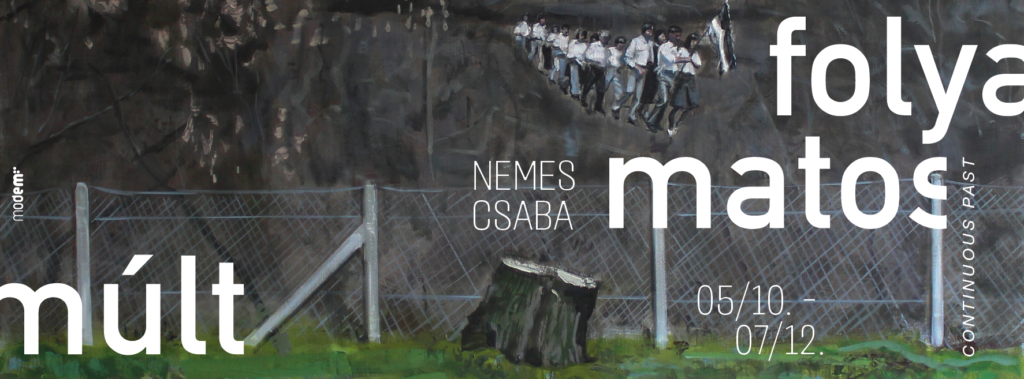
The exhibition provides a comprehensive overview of the artist’s more than three-decade-long practice, exploring recurring social, political, and cultural themes in his works through thematic focal points, from the period of the political transition in Hungary to the present day.
The exhibition is on view in the second-floor exhibition space from 10 May 2026 to 12 July 2026.
ABOUT THE EXHIBITION:
Continuous Past is the most comprehensive presentation to date of Csaba Nemes’s three-and-a-half-decade artistic practice, ranging from his neo-conceptual works of the early 1990s to the abstract paintings created in recent years. Rather than following a chronological structure, the exhibition examines the oeuvre through four thematic strands that run throughout the artist’s career. It builds on unexpected parallels and counterpoints between works from different periods, as well as on conceptual strategies and recurring motifs that emerge across several decades.
A defining characteristic of Csaba Nemes’s art is his critical reflection on contemporary social, political, and cultural processes, alongside his search for appropriate artistic forms to address the present. In addition to painting, drawing, and photography as his primary media, he has consistently employed a wide range of artistic tools, from animated film and linocuts to official documents and Lego sculptures. Viewed retrospectively, these reflections on the present form a historical trajectory, encompassing the visual and social transformations of the years of Hungary’s political transition, which coincided with the beginning of his career, through the events of October 2006, the Roma killings of 2008, the refugee crisis, the Living Memorial initiative launched in 2014, and the 2020 blockade of the University of Theatre and Film Arts.
At the same time, Nemes’s diagnoses of contemporary conditions repeatedly uncover a “continuous past” within the realities of the post-transition era: inherited historical traumas, grievances, and survival strategies; frozen relations of economic, ethnic, and ideological conflicts; social and cultural patterns that appear unbreakable or return in altered forms; endless struggles over memory politics; and the strengthening of conservative movements built on romanticised fictional narratives of the past.
The exhibition’s first section addresses these individual and collective, competing pasts that permeate the present, along with parallel or intersecting timelines and the legacy of twentieth-century history—particularly that of socialism, which imposed limitations while also creating possibilities. The second section guides visitors through various directions of Nemes’s consistent yet continuously evolving artistic programme, which is political and critical of systems of power while constantly experimenting with new approaches. Within this section, a separate area is dedicated to “socio-surrealism,” a practice that moves beyond realist representation and reflects on social reality through fiction and allegory, while addressing intersections of past and present through montage and visual metaphor.
The closing section brings together the various forms of abstraction that have long existed as an undercurrent within the oeuvre: from the found public-space elements appropriated as abstract artworks in the 1990s to the “genuine” abstract paintings created in the 2020s.
The four sections are complemented by a Film Corridor, presenting a selection of Nemes’s video works spanning two decades.
Curators: Tamás Don and Barnabás Zemlényi-Kovács