
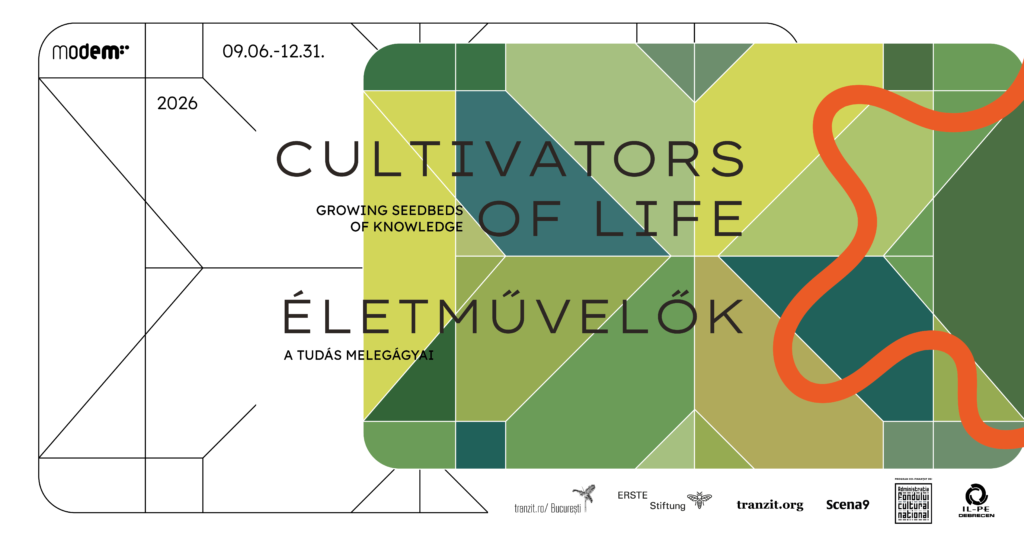
Cultivators of Life: Growing Seedbeds of Knowledge
2026. Sep. 06. - 2026. Dec. 31.
The exhibition brings together artists, gardeners and researchers to explore cultivation as a way of producing knowledge and imagining new relationships with the living world.
Organized by tranzit.ro/București in partnership with MODEM and curated by Adelina Luft and Krisztián Gábor Török, the exhibition presents artistic practices that approach cultivation not simply as agriculture, but as a form of knowledge production, community building, and ecological imagination.
Bringing together artists, researchers, gardeners, and community practitioners from Europe, the Caribbean, Latin America, and Southeast Asia, the exhibition explores how artistic practice intersects with ecology, science, indigenous knowledge, and everyday forms of care. Rather than treating the garden as a metaphor, Cultivators of Life understands it as a living structure where relationships between people, plants, soil, memory, and place are continuously cultivated.
🪴 Participants:
Alex Bodea (Berlin), Annalee Davis (Barbados), Aterraterra (Palermo), Colectivo Suumil Móokt’aan (Yucatán), Fuzzy Earth (Budapest), Harun Morrison (London), Horia Bernea (Bucharest), Kitti Gosztola & Bence Pálinkás (Budapest), Marina Sulima (Groningen/Chișinău), Martin Piaček (Bratislava), Mónica de Miranda (Lisbon/London), de Onkruidenier Collective (Amsterdam), Orsolya Gál (Cluj-Napoca), PARI feat. Anang Saptoto (Yogyakarta), Raluca Popa (Berlin/Bucharest).
Cosmos Garden at the Experimental Station for Research on Art and Life (with contributions from Raluca Voinea, Eduard Constantin, Adelina Ivan, and others), the Seed Bank Garden (Adina Moise and works from Codruta Birsan), Uzura Garden (Ana Barbu), Studio-Garden Crețești (Delia Popa), the garden of the Faculty of Agricultural and Food Science in Debrecen (documented by Lilla Váczi) alongside research about the kertségek (the garden districts of Debrecen).
🪴 Gardens as places of knowledge
At the centre of the exhibition are six gardens in and around Bucharest and Debrecen that became sites of artistic research, exchange, and long conversations with those who cultivate them. Their everyday practices of growing food, saving seeds, repairing, gifting, and mutual care embody what scholars Joe Smith and Petr Jehlička have described as quiet sustainability—forms of ecological resilience embedded in daily life rather than environmental activism. Their significance lies in the social worlds they sustain, quietly weaving together families, friendships, neighborhoods, and communities.
From these local contexts, the exhibition expands into a wider international dialogue, connecting artistic practices from Barbados, Yucatán, Yogyakarta, Amsterdam, Lisbon, Berlin, Bratislava, Palermo, London, Budapest, Chișinău, and beyond. Instead of proposing a universal model, Cultivators of Life brings together different ecological histories and situated forms of knowledge that remain rooted in their own cultural contexts while sharing concerns about biodiversity, collective memory, and future forms of cultivating life itself.
🪴 A two-year research programme
The exhibition concludes the two-year research and artistic production programme Cultivators of Life, developed by tranzit.ro/Bucuresti throughout 2025–2026 in partnership with MODEM. Conceived as a long-term research platform, the programme unfolded through artist residencies, public events in gardens, workshops, film screenings, field research, community meals, and the Conversations in Living Thought series coordinated by philosopher Ovidiu Țichindeleanu.
Much of the research was developed at the Experimental Station for Research on Art and Life in Siliștea Snagovului before expanding through artistic exchanges between Romania and Hungary, residencies at the Experimental Station and MODEM, and collaborations with communities whose cultivation practices became an integral part of the project.
This long-term process is reflected throughout the exhibition. Rather than presenting autonomous artworks, Cultivators of Life brings together works emerging from sustained relationships with places, gardeners, scientists, communities, and ecosystems.
🪴 The Gardens exchange
Alongside the artworks, the exhibition presents six gardens included in the programme: the Cosmos Garden at the Experimental Station for Research on Art and Life, the Seed Bank Garden, Uzura Garden, Studio-Garden Crețești, and two gardens from Debrecen. Together, they form a living archive of cultivation, research, and exchange developed over one year across Romania and Hungary. The exhibition also includes documentation produced during the garden exchange processes by writer Irina Bobei, illustrator Maria Doni, and photographer and filmmaker Gabriela Cozma.
More than the conclusion of a research programme, Cultivators of Life: Growing Seedbeds of Knowledge proposes the exhibition itself as a place where artistic practice, ecological thinking, scientific inquiry, and everyday knowledge come together to imagine new ways of cultivating life.
________________________________________
Curators: Adelina Luft and Krisztián Gábor Török
————————-
Cultivators of Life is a programme co-funded by the National Cultural Fund Administration (AFCN) in Romania. The exhibition is a project of the tranzit.org network. ERSTE Foundation is the main partner of tranzit.org.
The programme does not necessarily represent the official position of the National Cultural Fund Administration. AFCN is not responsible for the content of the programme or for any use of its results; responsibility belongs entirely to the beneficiary of the funding.